

Are the Greens for real?
A dispatch on UK politics by Oliver Eagleton


In Britain, the ritual of electing someone to Parliament usually involves a contest between two candidates, drawn from the increasingly indistinguishable Labour and Conservative parties, who feign disagreement for the duration of the campaign. The theatrics of democracy (debates, attack ads, manifestos) mask a shared commitment to the cult of Thatcher-Blairism, characterized by limitless faith in free markets and foreign wars.
Yet in Gorton and Denton — a working-class urban constituency in Greater Manchester, which held a high profile by-election last month — there was for once no need to create the illusion of choice. The division was genuinely Manichean. Hannah Spencer, a plumber with a thick local accent and amazing natural charisma whose platform centered on rising prices, faced off against Matt Goodwin, a far-right academic-turned-broadcaster who swooped in from out of town to incite hatred against the Muslim community, which makes up almost a third of the district’s population. This was the first head-to-head clash between the country’s new left and new right, represented respectively by the Green Party and Reform UK, whose rise over the past year has broken the century-long Labour-Conservative duopoly.
Nationally, Reform is polling in first place and primed to form the next government, ejecting the current Labour administration. But in Gorton and Denton, at least, the party’s strategy of smearing many of its would-be constituents as dangerous Islamists was not a winning one. Voters found Spencer’s program — lower bills, public ownership, migrant solidarity, peace abroad — more convincing. She trounced Goodwin with 40.7 percent to his 28.7 percent, while Labour, which had reigned supreme in this area for decades, languished at 25 percent.
Since the election, the entire British establishment has been wallowing in the first stage of grief: either denying the result with swivel-eyed claims of fraud, or dismissing it as a local aberration with no wider significance. Prime Minister Keir Starmer insisted that the “extreme” Green Party lacked the “resources, the activist base or the local knowledge to replicate this victory.” To any objective observer, though, the real meaning of the by-election was clear: Britain’s political landscape is undergoing rapid realignment, opening a possible road to recovery for a left that has spent years on the margins.
Starmer’s governing program — a poisonous blend of austerity, repression, racism, and jingoism — has fuelled his challengers at both ends of the spectrum, tightening the grip of reactionary nationalism in some parts of the country while affirming the need for a radical alternative in others. Though this process has so far been asymmetrical, with the right benefiting more than the left, Spencer showed that by building an alliance between the groups at the sharp end of racial animus and the wider strata who have suffered under the Starmer settlement (young people, lower-income workers), it is possible to reverse these fortunes. Not coincidentally, an analogous coalition has driven the UK’s Palestine solidarity movement — the largest in Europe — since 2023.
The Green Party’s success in bringing the full breadth of this bloc from the streets into the voting booth proves that it is now the nation’s only serious progressive electoral force, best placed to unite its fractured left. This is a development that I, like many others who spent the past year invested in building a new socialist party from the ashes of Corbynism, failed to predict. Our hopes for what ended up being called Your Party were dashed before it had even officially launched, as wreckers from two rival factions, led by Jeremy Corbyn and Zarah Sultana, devoted their energies to destroying one another and the project’s credibility therewith. Wrapped up in this catastrophe, many of us complacently assumed that the Greens’ historic identity as the home of self-satisfied middle-class liberalism would make them unelectable in key constituencies.
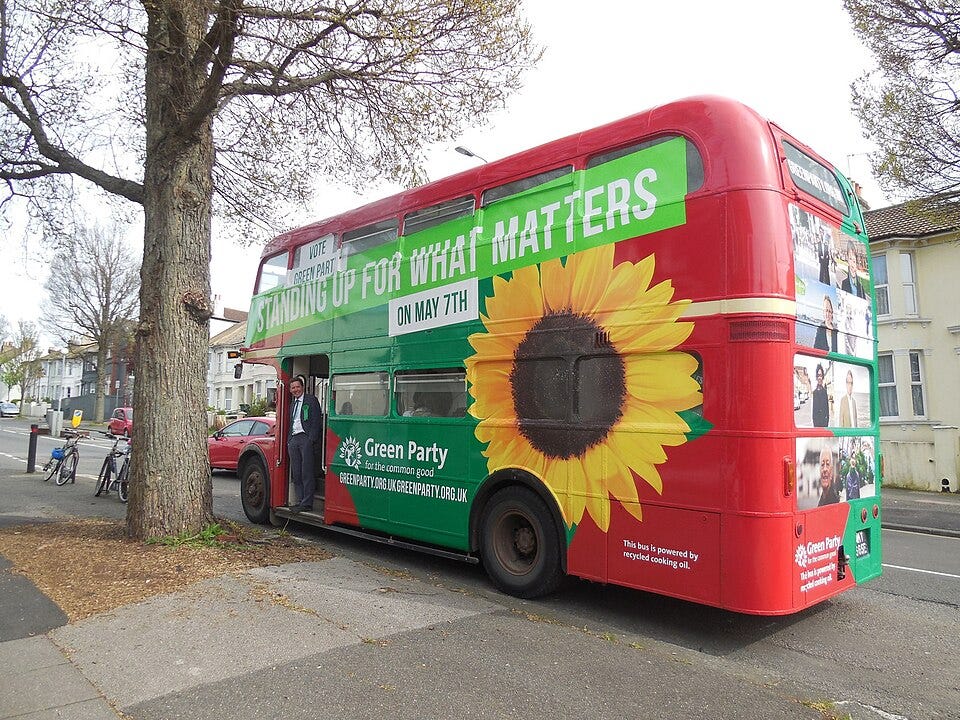
Yet the new eco-populist leadership of Zack Polanski, who has arguably channeled Corbynism’s legacy more effectively than Corbyn himself, has transformed the party’s reputation as well as its electoral prospects. Now supported by 21 percent of the electorate, just two points behind Reform, the Greens have combined a majoritarian politics focused on the cost of living with an uncompromising opposition to the Gaza genocide and a robust defense of migrants. Their ability to reconcile pluralism and principle, in a party where both were until recently in short supply, evokes the brighter moments of the left surge during the 2010s. While some reasonably distrust Polanski given his lack of participation in Corbyn’s stint as Labour leader, others claim that the dynamism of that movement can only be recaptured by a leader who was remote from it at the time and is not scarred by its defeat.
But let’s not get carried away. Every previous attempt to find a new institutional home for the British left outside the decaying Labour Party has foundered, since no single structure has been able to contain its disparate range of trade unionists, groupuscules, social media personalities, and single-issue campaigns, with all their micro-disputes and historical antipathies. As popular enthusiasm for the Greens continues to grow, the party will be subject to these same internal pressures. And as it becomes the main vehicle for the progressive vote, it will have to work out how exactly it relates to Labour: resolute opponent or potential coalition partner? If the Greens have surged by placing themselves on one side of the populist divide and Reform and Labour on the other, they risk losing their momentum — and sundering their constituency — by striking any deal to keep the far right out of power. These and other dilemmas loom. For now, though, there is a sense that the spirit of resistance which defeated the establishment in Greater Manchester might soon spread across the country.
Oliver Eagleton is managing editor at Phenomenal World and author of The Starmer Project.
https://thebluearmchair.substack.com/p/welcome-hannah-spencer-mp?r=5kmhkr
The current government has increased spending and benefits while increasing taxes by a larger amount. This is not austerity. The other ingredients in Starmer's blend are poisonous enough, but imprecise critiques risk good, non-austere reforms.