

Fighting for the future in occupied Minneapolis
On resisting ICE


Over the last two months, as I’ve tried to articulate the experience of being in Minneapolis during the Department of Homeland Security’s “Operation Metro Surge,” I’ve found myself repeatedly using war metaphors. An invasion of our community by a hostile occupying power: how else can I begin to accurately characterize the deployment of thousands of ICE, Border Patrol, and other federal agents, who have been given free rein to kidnap, brutalize, and even murder our neighbors with effective impunity — not to mention the threat of military forces being deployed under the Insurrection Act?
In retrospect, perhaps we should have seen it coming. There are many things about Minnesota — its rapidly diversifying population, recent history as the epicenter of the 2020 Black Lives Matter uprisings, and governor who was already in the crosshairs, to name just a few— that make it a prime target for the Trump administration’s wrath. And yet, in the early days of Operation Metro Surge in December, I and many other organizers of community defense efforts in the Twin Cities found ourselves face to face with the uncomfortable reality that we were not adequately equipped. We would have to build the plane as we were flying it.
Initial resistance efforts in Minneapolis in December primarily took the form of ad-hoc neighborhood patrols organized over Signal chats, bolstered by rapid-response networks that local organizations like the Monarca Network and the Minnesota Immigrant Rights Action Committee were already running. These efforts grew more sophisticated as time went on, but in these early days they were still a far cry from the much more robust (though still imperfect) community defense infrastructure that has begun to take shape in recent weeks. We also took shifts on “Whipple Watch” — monitoring the comings and goings of ICE agents at the Bishop Henry Whipple Federal Building, which houses an ICE field office and has become the epicenter of federal operations during Metro Surge — in order to build an ever-evolving database of the makes, models, and license plates of ICE vehicles. Each day brought an influx of new people to our ranks. And yet, we were constantly playing catch-up.
The new year, however, marked a turning point in both the intensity of Operation Metro Surge and the scale and organization of community resistance to it. On January 6th, the Department of Homeland Security announced the deployment of two thousand additional agents to the Twin Cities in what officials called “the largest DHS operation ever.” A day later, an ICE agent shot and killed 37-year-old legal observer and U.S. citizen Renee Nicole Good at the intersection of East 34th Street and Portland Avenue, just blocks away from where George Floyd was murdered by a Minneapolis police officer nearly six years ago. Far from scaring the people of Minneapolis into submission, the murder galvanized them in a way that had previously seemed impossible.
This jolt of energy was how I came to learn that the Signal app has a limit of a thousand users per group chat. A day or two after Good’s murder, the administrators of the main rapid response group for my neighborhood — just one of dozens that have emerged within Minneapolis alone — sent a message informing us that the chat had reached its maximum capacity, and was being split into two channels as a result. Within a week, the second chat had also reached capacity, necessitating the creation of a third — and since then, the admins have had to create yet another channel to meet the demand. In other words, the number of people who have joined community defense efforts in one part of South Minneapolis in just the last few weeks is higher than the total number of federal agents who have been deployed to Minnesota since the beginning of Operation Metro Surge.
Expressions of solidarity have become a feature of daily life in the Twin Cities. Neighborhood meetings in which people have learned how to create hyperlocal community defense and support infrastructure have drawn hundreds and packed overflow rooms in churches and schools across the Twin Cities. Networks have come together to coordinate accompaniment, carpooling, and grocery delivery for vulnerable neighbors, and every day community members stand watch outside local schools during arrival and dismissal times. Several times, when I’ve driven through my neighborhood in pursuit of an ICE vehicle, honking and blowing a whistle out the window to draw attention, I’ve been joined by onlookers in their own cars or following on foot, who whistle alongside me or film the agents. In the shared project of defending our home, each of us has a role to play.
This community mobilization prepared the people of Minneapolis to respond when, less than three weeks after Renee Good was killed, Customs and Border Patrol officers executed Alex Jeffrey Pretti in broad daylight, fatally shooting him multiple times while he was pinned to the ground — all after having already taken away the handgun that he was legally carrying and never unholstered. In the immediate aftermath of the shooting, the clashes that erupted between protesters and riot gear-clad law enforcement near the site of the murder were even more intense than those that took place after Good’s killing. Community members barricaded the streets surrounding the intersection where Pretti was killed, and local businesses opened their doors to protesters seeking shelter from tear gas and other chemical weapons.
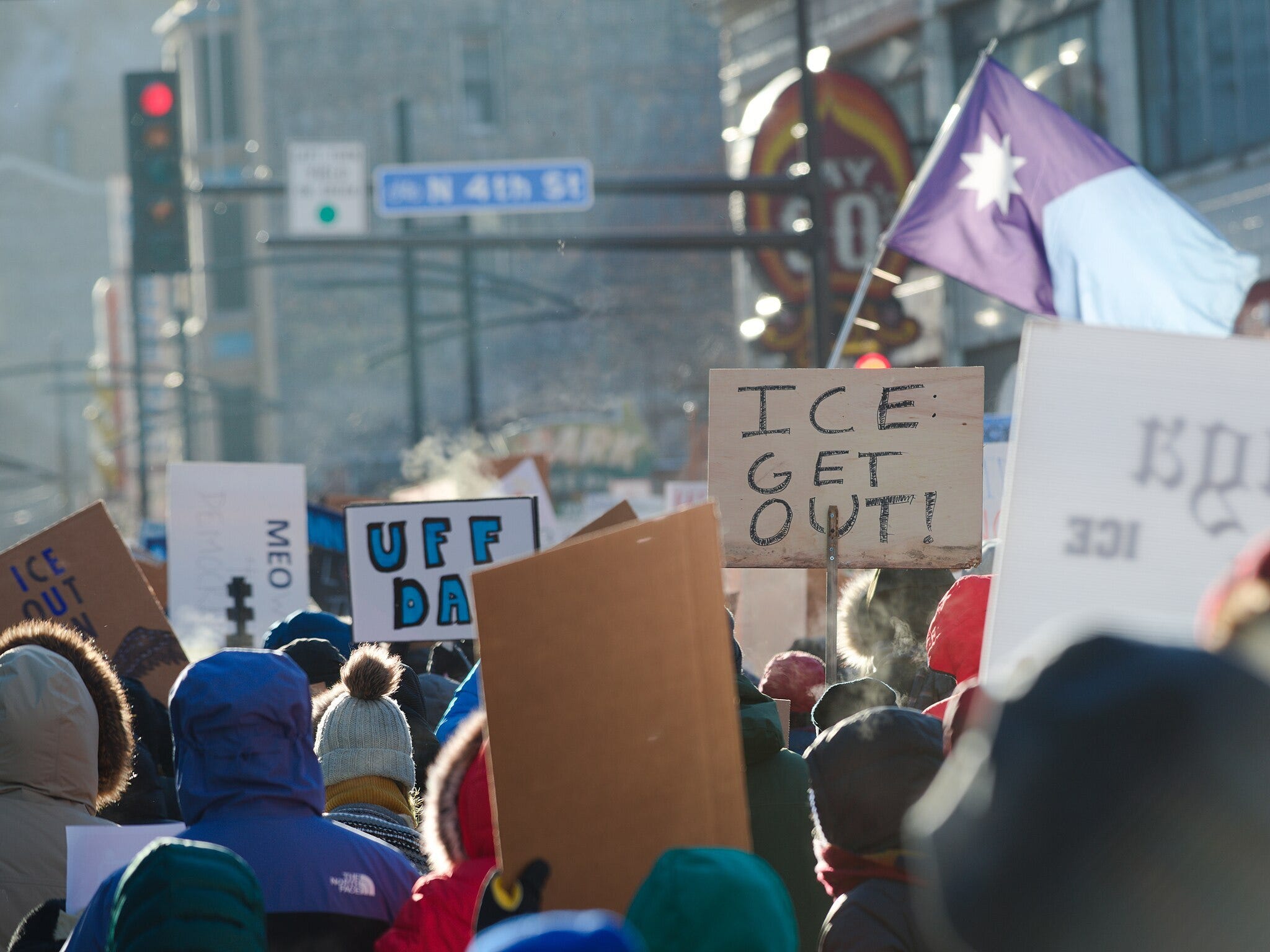
The general strike of Friday, January 23, which was endorsed by more than a dozen major local unions and several prominent community organizations as well as dozens of local, state, and national elected officials, was perhaps the most spectacular example of mass mobilization yet. Hundreds of businesses closed their doors, both in the Twin Cities and across the state, and more than 50,000 people took to the streets in downtown Minneapolis, braving wind chills as low as -35°F. My comrades and I often make reference to the idea of “developing mass protagonism,” a concept with roots in Latin American Marxist thought that expresses an understanding that successful organizing means helping people see themselves not merely as passive subjects of history, but as active agents with the collective power to bring about revolutionary transformation. I have become increasingly convinced that rather than asking people what radicalized them — a familiar question for anyone who has spent time in left activist circles — a better query would be: what protagonized you? Over the last several weeks, whether or not they realize it yet, thousands of people across Minnesota have found an answer to that question.
In order for this feeling to stick, however, a great deal rests on what happens after the current crisis subsides. When the last ICE agent packs up and leaves, will those who have been newly galvanized simply breathe a collective sigh of relief and return to business as usual? Or will they continue to build on these still-nascent foundations of grassroots power and community self-defense? Time and time again, in neighborhood gatherings and organizing conversations, my comrades and I have found ourselves repeating the same refrain: If only we’d had this infrastructure back when this crisis started. This refrain, however, has an important corollary: If we keep this up, imagine how much better prepared we’ll be when the next crisis rolls around. For those of us in Minneapolis, the task at hand is to figure out how to sustain our infrastructure well beyond the conclusion of the current crisis. For those in other cities, the task is to begin building their own infrastructure before the crisis reaches them.
Pranay Somayajula is a Minneapolis-based writer, organizer, and political educator whose work focuses on imperialism, anti-colonial resistance, and decolonization. He runs the Substack blog “culture shock” and hosts the anti-imperialist political education podcast “Return to Bandung.”
The Drift is supported by its readers. Your subscription or donation will help us continue to pay our writers and artists and grow our magazine. We are a 501(c)(3) nonprofit, so donations are tax-deductible.
 | A guest post by
|