This is the first installment of a new column by Max Norman on contemporary art.
The American pavilion at this year’s Venice Biennale is an opportunity missed and a responsibility shirked. For a while, it was unclear whether the U.S. would be represented at all. The State Department, which oversees the delegation, didn’t seem to begin the selection process until late April of last year: after Vanity Fair’s Nate Freeman inquired, the usual application for proposals finally went live online, scrubbed of references to diversity, but preserving its token insistence on the “non-political character” of exhibitions. Early rumors suggested the show might nonetheless comment on the chaos of which it would be a product. Robert Lazzarini’s warped take on American iconography — which fell through, apparently, due to negotiations over funding — would have named the elephant in the room. Even Curtis Yarvin’s hypothetical “Salon des Déplorables” featuring “dissident-right art hos” would have actually invited discussion, albeit of the debased variety extruded from the algorithms that govern the Trump era. The American right has been intent on remaking cultural life, and here was a golden opportunity to offer something more interesting, if more repulsive, than the predictable progressivism of Jeffrey Gibson’s 2024 pavilion. After all, the Biennale itself — expanded by Mussolini, and an important venue for the Futurists — testifies to the fact that fascism, for all of its many evils, can be aesthetically interesting, even revolutionary.
Instead, the American exhibition is so anodyne that it hasn’t even provoked a protest. The five-person jury tasked with awarding the festival’s three major prizes resigned on April 30, refusing to consider any nations “whose leaders are currently charged with crimes against humanity by the International Criminal Court,” which meant Israel and Russia; nearly half of the Biennale’s artists have withdrawn themselves from consideration for awards in solidarity. (Two “Visitors’ Lions” will be decided upon in November by a poll of visitors.) A phalanx of cops and private guards patrol the Israeli pavilion, and Pussy Riot recently descended upon the Russians. But, setting aside a flurry of bad press in the lead-up, the collection of sculptures by the artist Alma Allen staged in the American pavilion has been greeted with a resounding shrug. Frieze found it “vacuous”; Hyperallergic dismissed it as “a whole lot of nothing.” “Bronze may be heavy, but this is as insubstantial as air,” wrote New York Times critic Jason Farago.
Allen lives in Mexico City and is often described as “self-taught,” but he is far from an art-world outsider. He participated in the 2014 Whitney Biennial, though his greatest exposure has been on the traffic medians of Park Avenue, where a number of the Venice sculptures were exhibited last year. After several more established artists declined, reportedly including William Eggleston and Barbara Chase-Riboud, Allen was tapped last November, a mere six months before the opening of the Biennale. His last-minute selection, and the slapdash pavilion in which his works are displayed, are typical of the new American bureaucracy. Like many administration appointees, Allen played a bit part until being catapulted to main character, and the other protagonists are even more improbable: before heading up the American Arts Conservancy, the freshly incorporated nonprofit sponsoring the pavilion, Jenni Parido founded Tampa-based Feed Pet Purveyor, “a healthy lifestyle market for dogs, cats, birds & the people who love them.” The pavilion’s curator, Jeffrey Uslip (full disclosure: we’ve met and corresponded a few times), found his promising early career derailed in 2016 after a controversial show at the museum where he worked in St. Louis — just minutes from Ferguson — of paintings by the white artist Kelley Walker, who appropriated images from black civil rights magazines, smearing some with chocolate and toothpaste; except for co-curating the 2022 Malta Pavilion, he has largely retreated to the shadows.
And like so much of Trumpworld, Allen’s show, “Call Me the Breeze” — which shares its title with a 1974 Lynyrd Skynyrd track — seems more suited to a luxury mall in Miami Beach than the world’s most important, and most political, art event. Farago, echoing the architect James Wines, called the Park Avenue sculptures “plop art.” But another word inevitably came to mind as I walked among shiny, striated surfaces, compact blobs, and chemically stained wall hangings: “slop.”
The 25 sculptures — mostly in bronze, some in stone, and one in wood — are inoffensive, occasionally handsome, sometimes silly, and on the whole unremarkable. They’re not quite abstract, not quite figurative, not quite anything at all. (They are also all “Not Yet Titled.”) Though they might be parsed in terms of postminimalism or indigenous craft or biomorphism, the label most often associated with Allen, they don’t really participate in tradition. There are echoes of Brâncuși and Noguchi, among others, but no allusions. The materials — particularly the veined marble walnut burl — are often more interesting than the forms, which might be appropriate for a culture that fetishizes mineral over intellectual resources. There’s syntax but no sense, and the show is a jumble of mixed registers and messages, whose apparently apolitical incoherence masks the deeply political conditions that made it possible in the first place.
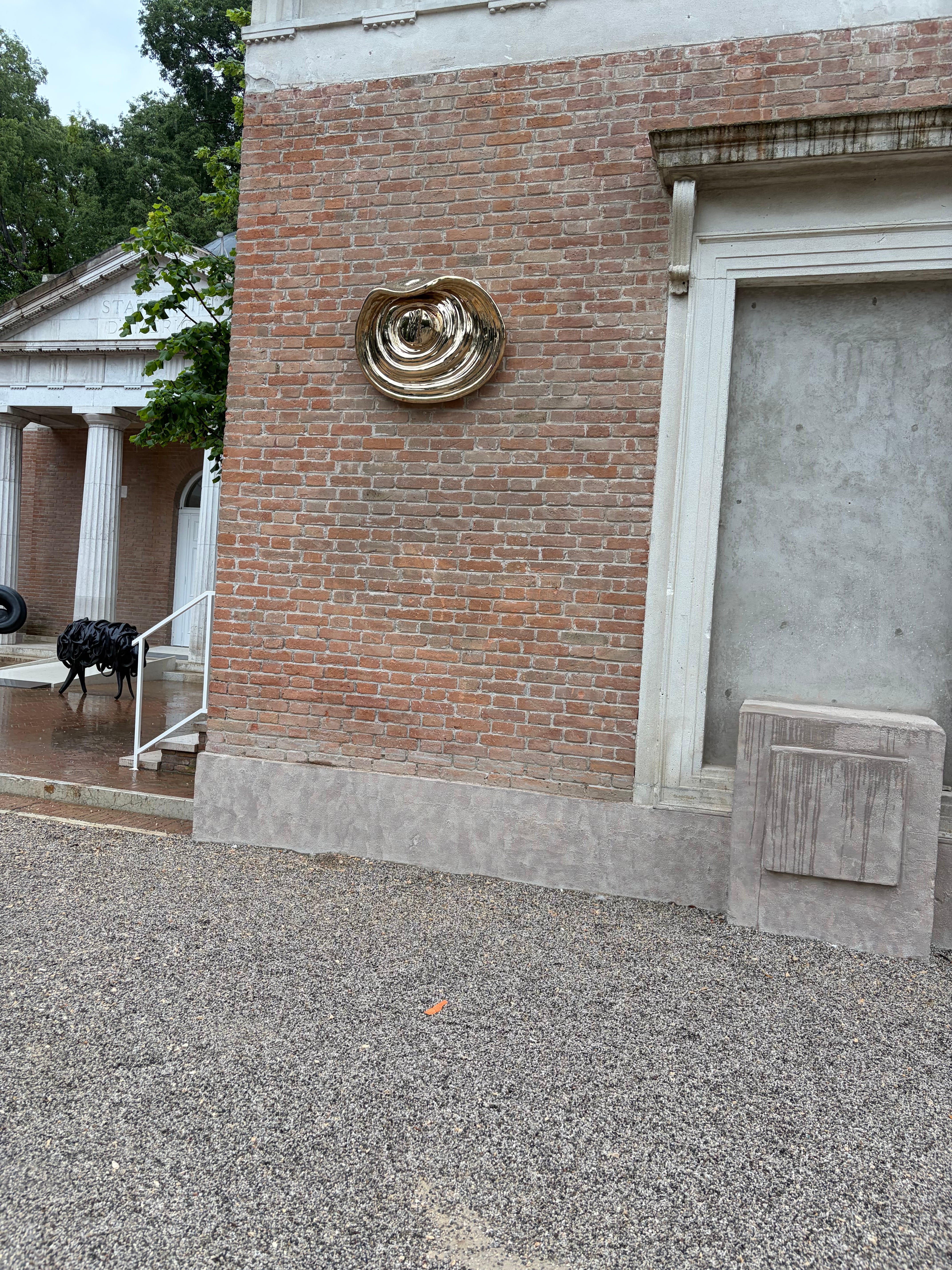
In a jargon-laden curatorial statement, presented, of course, only in English and itself worthy of ChatGPT, Uslip tells us that these works are meant to resist meaning, but he and Allen both gloss the sculptures with banal readings. Allen has told the press that his show is inspired, somehow, by Hieronymus Bosch’s “Visions of the Hereafter” in the nearby Accademia museum. The pavilion’s forecourt is dominated by two large bronze pieces, out of whose bases of snail-like curls sprout phallic booms, angled toward each other like the cannons of two tanks; one of them, Allen told Vanity Fair’s Freeman, is a version of Don Quixote. Parked behind them is a rectangle on four legs swaddled in shaggy, linguine-like strips, which, Allen told Freeman, represents “a black sheep.” Allen has suggested that the first piece you see upon entering — a 2016 mushroom-shaped totem some four feet tall and made of coral-colored Persian travertine — is a mushroom cloud. In the same room, a waist-high human figure made of a striated reflective bronze stands on a small pedestal like a blinged-out garden gnome, as if you asked Midjourney to cross Joel Shapiro with Lynda Benglis. In another room a massive human form, also in polished brass, clutches its knees in a corner. But if Shapiro’s humanoid abstractions evoke the vertiginous feeling of bodies in precarious balance, and Benglis’s swoops seem slyly to defy their materiality, Allen’s two human figures are, despite their wavy limbs, static and inert (as are many of these sculptures, which sit heavy on the floor, volumes that reminded me of anchors and ploughs). So, apparently, is their meaning: in a wall text, Uslip seems to call the smaller form “a young person witnessing ‘the terror of war.’” The best piece in the show might be the shiny brass disk hung on the outside of the Pavilion, a watchful eye in which passersby can see their reflections; unlike the show’s sometimes vapidly monumental wall pieces, this is the only sculpture which really seems to pose a question, eliciting our attention rather than expecting or demanding it.
“Call Me the Breeze” is pablum. But this pablum is perversely presented as high-minded courage to “open dialogues and foster discourse,” and resist the polarization of which it is a direct result. “We are at a critical moment in culture,” Uslip concludes in his wall text. “As the nation approaches its semiquincentennial, celebrating the 250th anniversary of the signing of the Declaration of Independence, the United States Pavilion champions art that favors deep time, eschews finite positions, and encourages artistic autonomy and curatorial independence.” In other words, art that recognizes the overwhelming concerns of the present and nonetheless decides not to say much of anything about them — and curation that chooses decoration over real discourse, let alone the risks our culture so badly needs. (“Here is the biggest risk of my life except for all the other ones,” Allen says in his artist’s statement, which might as well have been a quotation of the Skynyrd song.) With Trumpian contempt for his critics, Uslip told the Financial Times that he is “embarrassed” and “sad” for those disappointed with the lack of political content in Allen’s art. “Have you given up on the agency and promise of art? On what art can do, uniquely to itself?” But it’s this pavilion that evinces little belief in art’s agency and promise to do much of anything at all.